Addressing the school tree-shade-gap is a matter of environmental and climate justice

Read this featured in the Guardian.
During the recent June and July heatwaves, we have seen the ability of our public spaces, homes and buildings to withstand extreme temperatures well and truly tested. This has been particularly pronounced in schools, where reports have surfaced of the huge challenges faced by staff and pupils, including classrooms reaching dangerous temperatures and teaching becoming pretty much impossible.
Multiple factors affect how schools respond to heatwaves: the materials used in their construction, the extent of glazing, the presence or absence of insulation and ventilation, playground surface materials, and the amount of shade and nearby greenspace - as well as how well resourced and supported teachers and support staff are to adapt their teaching and routines. Some newer buildings, with large amounts of glass and hard surfacing, have become heat traps.
Trees block direct sunlight, reduce heat absorbed by hard surfaces, and cool the surrounding air. They also bring wider benefits: improving air quality, supporting biodiversity, improving wellbeing and creating richer outdoor learning environments. Urban trees can make a significant difference, in parts of the country particularly affected by extreme heat - helping to counteract the urban heat island effect - heating urban spaces up to 12 degrees more than surrounding countryside. Work carried out by Friends of the Earth has highlighted the most at-risk areas, taking into account multiple factors of vulnerability.
I have long been aware, through working with schools, that access to green space and trees in and around school grounds is highly unequal. Some schools have mature grounds, large playing fields and established trees. Others have small, hard-surfaced sites, with a few planted borders but very little green space. There are also regular reports of trees being cut down in school grounds because of concerns over safety, maintenance costs or ease of management.
Much of what I know about greenspace in schools is based on my personal experience, and through what i've gleaned from years of working with teachers and educators. The heatwaves this year made me think more about the function and benefits of trees though. I'd learnt through conversations with friends that schools without trees were struggling - buildings were getting too hot, and opportunities to take lessons out into the shade were limited - this contrasted with schools where plentiful shade is present - this is no accident, someone decided that trees were or were not important in school grounds, and as we move into increasingly challenging times the same descison makers will need to take notice of how greenspace functions to support children through extreme heat.
The Research
Forest Research’s recently released Trees Outside Woodland dataset has made this newly possible. For the first time, it allows a national-scale view of smaller groups of trees and individual trees outside mapped woodland, including street trees, trees in parks, gardens and school grounds and so on. The dataset maps trees in England above 3 metres in height and with a canopy area of at least 5m² where they sit outside the National Forest Inventory woodland map. By combining this with existing mapped woodland data, and comparing the combined tree and woodland cover with the locations of schools in England, I was able to establish tree cover within 100 metres of each school location.
Independent (otherwise known as private) schools in England have substantially more nearby tree cover than state-funded mainstream schools. Across school-age settings (including all-through and 16+), independent schools have a median nearby tree cover of 19.6% , compared with 13.9% for state-funded mainstream schools. That gives independent schools 41% more nearby tree cover than comparable state schools - a sizable advantage for children and young people's health and wellbeing.
Inequality is also visible within the state sector when looked at seperately. Among state mainstream schools, those with the highest levels of free-school-meal eligibility (a proxy for economic status within school catchments) have a median nearby tree cover of 11.8%, compared with 16.3% for schools with the lowest FSM levels. In other words, state schools in poorer catchments have around 28% less nearby tree cover.
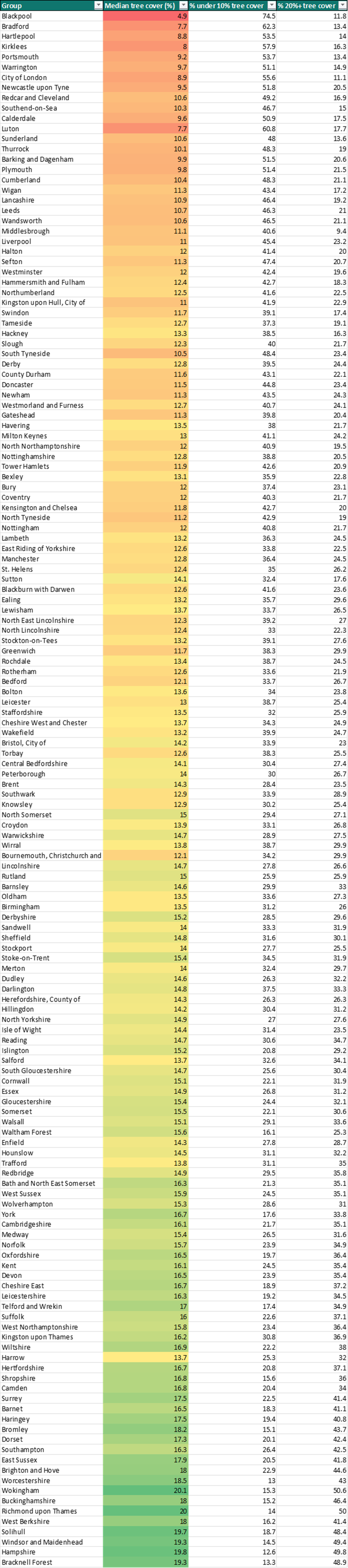
Some local authority areas have particularly low median tree cover around schools, including places where heat vulnerability is already a concern. Blackpool, Bradford and Hartlepool rank amongst the least well off in terms of tree benefits, with 4.9%, 7.7% and 8.8% respectively. Plymouth stands out in the South West as a Local Authority with extremely low relative school-tree cover (9.8%, compared to the rest of Devon at 16.5%), as well as being a flashpoint for council sponsored tree felling in recent years. These are the kinds of areas where targeted tree planting around schools could make the greatest difference.
Summaries of Local Education Authorities (England) with median tree cover %:
The wider story here is about environmental inequality being reproduced in children’s everyday surroundings. The children most likely to face the combined pressures of deprivation, poor environmental quality and extreme heat are often those with the least nearby shade.
Trees in and around school grounds offer vital shade during heatwaves like the ones we have just experienced. I believe it is unacceptable that these benefits are so unevenly distributed, with more advantaged children more likely to attend schools with greener, better-shaded surroundings. The Local Education Authorities ranking at the top of the list above should be prioritising tree planting in and around school grounds - we only need to look at initiatives in California for both inspiration and forewarning. To paraphrase a well known saying, the best time to plant trees in school grounds was 30+ years ago, the second best time is now.
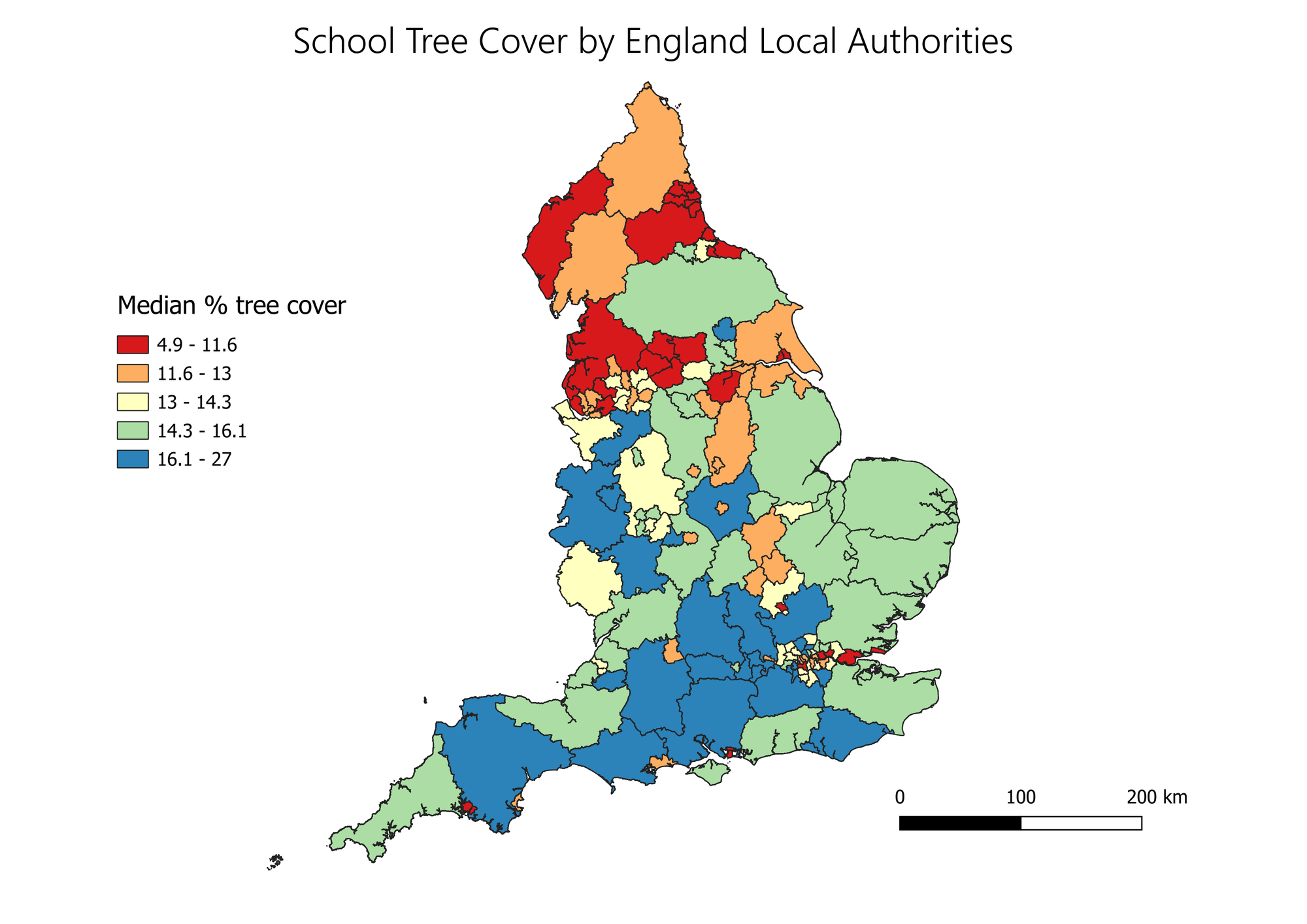
Notes on the methods and research:
This analysis measures tree and woodland cover within 100 meters of school locations. It does not tell us whether the trees cover consists of trees only inside the school boundary, whether children can access them, or how much shade falls on playgrounds and classrooms at particular times of day. It also does not measure the age, condition or design of school buildings. But it does provide a national picture of the uneven distribution of nearby trees and, by proxy, the uneven distribution of shade and cooling potential around schools. The analysis also focuses on school location as a single point - so schools with multiple premises or a distributed set up will not be fully accounted for (although these are in the minority of cases - unfortunately this is the case for the schools on the Scilly Isles, hence their removal from the dataset).